At some point, most bloggers run into a weird phase where growth just… stops.
You publish posts → You share them → You even update old articles.
And somehow the traffic graph just sits there doing absolutely nothing for weeks.
If you’ve been blogging for a while, this stage can be really confusing. One month you’re seeing steady growth, and the next month things slow down for no obvious reason.
I’ve seen this happen to personal blogs, niche sites, and even fairly large tech blogs. It doesn’t always mean something is “broken.” More often, it means the strategy that got you here isn’t the strategy that will take you further.
So if your blog stops growing, here’s how experienced bloggers usually diagnose the problem and turn things around.
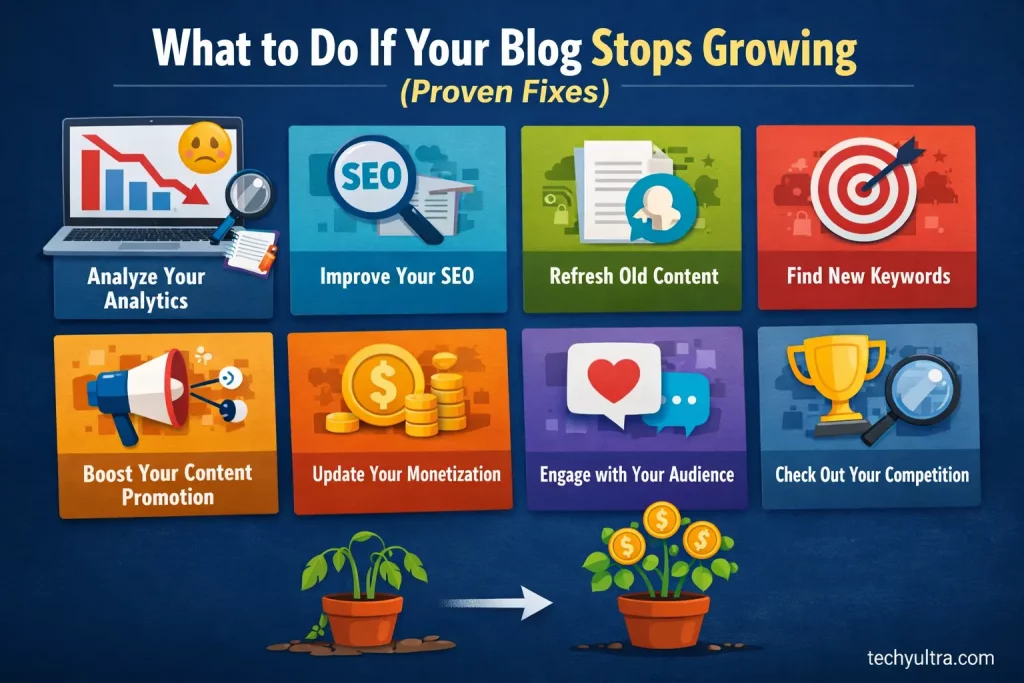
First: Understand Why Growth Slowdown
Before trying random fixes, it helps to understand what’s actually happening.
Most blogs don’t stop growing because of one big mistake. It’s usually a combination of small things that stack up over time.
A few common patterns show up again and again.
1. You’ve Already Captured the Easy Traffic
Early blog growth often comes from low-competition topics.
Examples:
- beginner guides
- basic tutorials
- simple how-to searches
At first, these work surprisingly well.
But eventually:
- you’ve covered most of them
- competitors publish similar content
- Google already has strong pages ranking
This is where many bloggers run into blog growth problems without realizing it. Early on, it almost feels like you can publish anything and it’ll get traffic.
Later, things become more strategic.
2. Your Content Isn’t Differentiated Enough
At this point, Google has seen an absurd number of blog posts.
If your article looks like the other 20 results on the page, it’s honestly hard to stand out, even if the content itself is decent.
A few signs this might be happening:
- similar headings to every other article
- generic advice
- no real experience behind it
- surface-level explanations
Over time, search engines seem to prefer content that adds something new instead of repeating the same advice everyone else is giving.
3. Your Old Posts Are Slowly Losing Rankings
This is one of the most overlooked issues.
Many bloggers focus only on publishing new content.
Meanwhile:
- old statistics become outdated
- competitors update their articles
- search intent changes
Traffic slowly leaks away.
If you check Google Search Console carefully, you’ll often see that older posts are quietly dropping positions.
The Hidden Plateau Most Bloggers Experience
There’s also something I like to call the “mid-stage plateau.”
It usually happens when a blog reaches somewhere between:
- 50 articles
- 150 articles
At this point:
- beginner topics are exhausted
- authority is still building
- competition increases
Growth slows.
This doesn’t mean the site is failing. It just means the next stage requires smarter blog growth strategies, not just more posts.
Step One: Audit What’s Actually Happening
Before changing your strategy, look at real data.
Not guesses.
Open:
Look for three things.
Which Posts Are Losing Impressions
Many bloggers assume traffic problems come from new posts not ranking.
But often the real issue is older content fading.
Sort by:
Queries → impressions → declining pages
Sometimes refreshing just 5–10 articles can revive a large portion of your traffic.
Which Posts Are Stuck on Page Two
Posts stuck on page two are often the easiest wins.
These articles already have some momentum.
Small improvements like:
- better headings
- clearer structure
- updated information
can push them onto page one.
This is honestly one of the safest ways to increase organic traffic blog owners overlook.
Content Depth Matters More Than Publishing Frequency
There’s a common belief that publishing more often solves traffic problems.
Sometimes it does.
But often it doesn’t.
If your last 30 posts all target similar keywords with similar depth, Google doesn’t have a reason to rank them higher than existing results.
Instead of asking:
“What should I publish next?”
Ask:
“What can I publish that is genuinely better than what exists?”
That small shift in thinking can make a big difference.
Improve Blog SEO Without Overcomplicating It
SEO advice online can get very technical, very quickly.
But in many cases, blogs that stop growing are just missing a few basics.
Search Intent Is Everything
When someone types something into Google, they expect a specific type of answer.
Examples:
Bad match
Keyword: best budget laptops
Article: general laptop buying guide
Good match
Keyword: best budget laptops
Article: curated list with comparisons and prices
This sounds obvious, but a huge percentage of blogs miss this.
If you want to improve blog SEO, start by checking the current top results and ask:
- What type of article is ranking?
- What format does Google prefer?
Then build something better.
Internal Linking Is Wildly Underrated
A lot of bloggers barely think about internal links.
But they help search engines understand your site structure.
For example:
A post about blogging tools should naturally link to:
- keyword research guides
- SEO tutorials
- traffic strategies
Over time, this builds topic authority.
Big sites rely on this a lot, but smaller blogs often ignore it completely.
One Problem I See Constantly: Writing Only for Search Engines
Ironically, writing purely for SEO can kill growth.
Readers notice when content feels mechanical.
You’ve probably seen posts like this:
- overly optimized headings
- repetitive keyword phrasing
- generic explanations
They might rank for a while, but they rarely build real readers.
The blogs that grow steadily usually have a bit of personality behind them.
A few opinions.
Some experience.
Maybe even a small rant about tools that don’t work.
It makes the content feel real.
Content That Actually Builds Authority
Not all blog posts are equal.
Some attract quick clicks.
Others build long-term credibility.
Here are a few types that tend to perform well over time.
Experience-Based Articles
Instead of generic advice, write from something you’ve actually tested.
Examples:
- tools you used for six months
- experiments that worked
- strategies that failed
Readers trust this more than theoretical guides.
Deep Guides
A lot of blogs publish shallow 800-word posts.
But when someone finds a genuinely helpful, detailed guide, they tend to stay longer and share it.
This signals quality to search engines.
Depth doesn’t mean fluff.
It means covering the topic fully.
Updated Resource Posts
Technology changes constantly.
Posts like:
- tool comparisons
- updated lists
- platform guides
age quickly, but they also attract steady traffic when maintained.
Refreshing them periodically is surprisingly powerful.
A Quick Word About Competition
Sometimes the real reason traffic slows down is simple:
Your niche became more competitive.
This happens a lot in tech, blogging, and finance.
New websites appear.
Established sites expand into your topics.
AI-generated content floods search results.
It doesn’t mean growth is impossible. It just means standing out takes more effort than it used to.
That’s where smarter blog growth strategies start to matter.
The Traffic Source Many Bloggers Ignore
Search traffic is great.
But relying on only Google can make growth unstable.
Smart blogs usually combine several channels:
- search
- direct visitors
- social
- referrals
Even a small email list can stabilize traffic.
If search dips slightly, readers still come back.
This also signals trust around your content.
Updating Content Is More Powerful Than Writing New Posts
This surprised me when I first noticed it.
Refreshing existing posts often produces faster results than publishing new ones.
A typical update might include:
- fixing outdated information
- improving structure
- adding clearer explanations
- including recent examples
Sometimes rankings improve within weeks.
Search engines tend to favor content that’s maintained and updated.
Abandoned blogs gradually fade.
Technical Issues That Quietly Kill Growth
Most bloggers don’t notice technical problems until traffic drops significantly.
A few things worth checking occasionally:
Slow Page Speed
Readers leave quickly if a site loads slowly.
Google also considers speed as a ranking factor.
Common causes:
- heavy themes
- unoptimized images
- too many plugins
Mobile Experience
A large portion of blog readers come from mobile devices.
If text is cramped, popups are aggressive, or layout breaks, people bounce.
Indexing Problems
Sometimes new posts aren’t indexed properly.
Checking Search Console occasionally can reveal surprises.
The Beginner Mistakes That Stall Blogs
Many growth issues trace back to habits formed early on.
A few patterns appear often.
Publishing Without Keyword Research
Some bloggers write whatever comes to mind.
That’s fine for personal blogs, but traffic-driven blogs need search demand.
Otherwise even great posts may remain invisible.
Targeting Extremely Competitive Topics
Trying to rank for massive keywords too early can be frustrating.
Smaller, specific topics build momentum first.
Authority grows gradually.
Expecting Quick Results
SEO can take months.
Sometimes longer.
Many blogs quit just before their content starts gaining traction.
Consistency still matters more than most people want to admit.
Small Improvements That Compound Over Time
Blog growth rarely comes from a single viral post.
It usually comes from small improvements stacking together.
For example:
- slightly better keyword targeting
- clearer article structure
- faster loading pages
- internal links between related posts
Each one seems small, but together they slowly change how search engines see your site.
This is how blogs slowly escape blog growth problems and begin climbing again.
Patience Is Still a Real Factor
One uncomfortable truth about blogging:
Some things just take time.
Authority builds slowly.
Backlinks accumulate gradually.
Trust from readers grows post by post.
Even when everything is done correctly, growth isn’t always linear.
You might see:
- quiet months
- sudden jumps
- unexpected plateaus
That’s normal.
A Personal Perspective After Watching Many Blogs Plateau
I’ve watched a lot of bloggers panic when their analytics flatten.
They redesign their site, change niches, or start publishing daily.
And honestly, sometimes the fix is simpler than people expect.
Improve what already exists.
Write from actual experience.
Pay attention to what readers are searching for.
And just keep going longer than most people do.
The internet is full of abandoned blogs that were probably a few months away from traction.
If your blog stops growing, treat it as a signal, not a failure.
It’s usually the moment when blogging shifts from casual publishing to thoughtful strategy.
And honestly, that’s usually where things start getting interesting.

Hi, I’m Aditya Sharma, a BSc in Radiology student and founder of Techy Ultra, a tech blog covering AI tools, Android tips, blogging, online earning, digital tools, useful apps and software tips & tricks. I have a self-taught background in tech field and like to share information from this blog.