If you run a website long enough, there comes a moment when you ask a slightly uncomfortable question: “Why is that site ranking above mine when my content feels better?”
I’ve asked that question myself more times than I can count. And the deeper I went into search quality, the more uncomfortable the realization became: Google isn’t judging websites the way most people think it is. It’s not just counting keywords, backlinks, or word count. It’s judging trust, usefulness, intent, and long-term value.
Most explanations of Google’s quality systems focus on checklists and ranking factors. I don’t think that’s how the problem should be approached, so this article takes a different angle, one based on how people actually interact with websites.
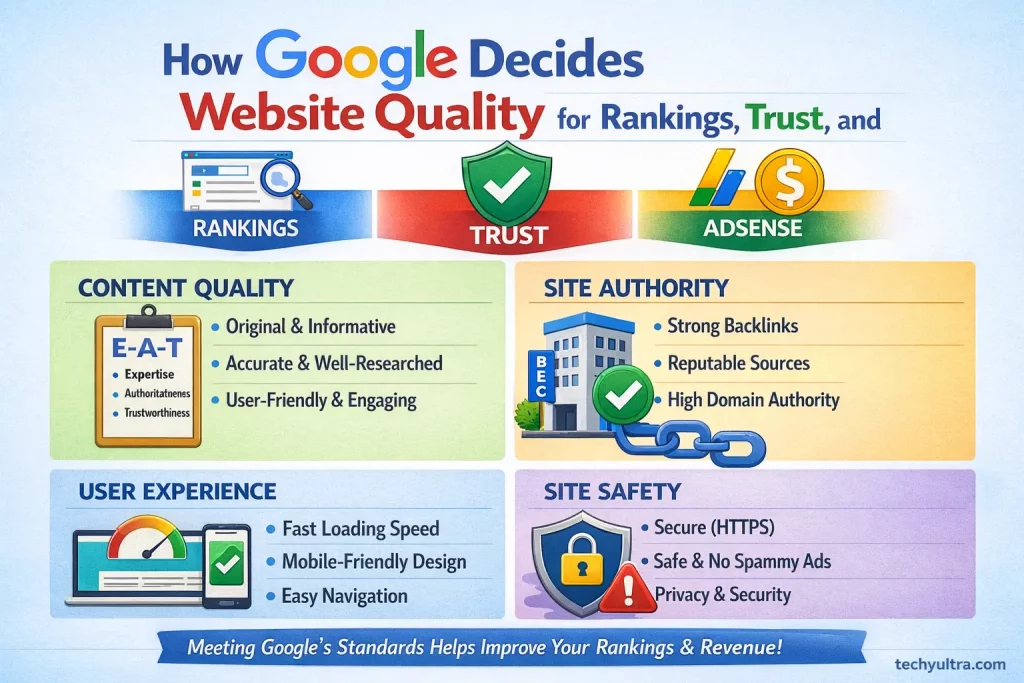
First, let’s clear a big myth about Google
Google doesn’t wake up one morning and randomly decide a website deserves to be punished.
That belief causes more panic in SEO than almost anything else I’ve seen, mostly because it turns ranking drops into something emotional instead of analytical. In reality, what usually happens is far less dramatic and harsher in a quieter way. Google simply finds better pages, and the older ones stop getting picked.
Google continuously tries to filter out content that does not deserve attention. If your site drops, it usually means Google found better alternatives, not that it suddenly hates you.
Understanding this mindset is the foundation of understanding how Google decides website quality.
Google’s real goal (and it’s not ranking your website)
Google’s primary mission is brutally simple:
Give users the best possible answer with the least possible effort.
Everything else algorithms, updates, guidelines exists to serve that single purpose.
If a user searches something and:
• Clicks a result
• Feels satisfied
• Doesn’t bounce back
• Doesn’t need to refine the search
Google considers that a success.
Your website quality, in Google’s eyes, is measured by how consistently you help Google achieve that success.
This is where many websites fail. They try to impress Google instead of helping users.
The invisible judge: Google’s quality evaluation system
Google does not manually review every website. Instead, it uses a layered system made up of:
• Algorithms
•Machine learning systems
• Quality rater feedback
• Historical performance data
Human quality raters don’t directly affect rankings, but they train the systems that do. Their guidelines are a window into Google’s thinking and those guidelines revolve around one concept more than any other.
EEAT explained (Google cares more about this than you think)
If you’ve ever heard people talk about EEAT explained Google, here’s the simplest interpretation:
At its core, Google wants to know whether your website deserves to be trusted by real people making real decisions.
EEAT stands for: Experience, Expertise, Authoritativeness, Trustworthiness
Notice something important here: experience was added later. That wasn’t an accident.
Google realized that theoretical expertise isn’t enough. First-hand experience matters, especially for health, finance, and life-impacting topics.
If your content feels like it was written by someone who has never actually dealt with the topic, Google can sense it indirectly, because users sense it first, in how long they stay, whether they return, and whether they actually trust what they read.
Experience: the most underrated quality signal
Experience is about lived knowledge.
Let’s say two articles explain the same topic. One is technically correct. The other includes real struggles, mistakes, lessons learned, and context.
Which one would you trust?
Google sees this difference indirectly through:
• User engagement
• Dwell time
• Return visits
• Brand searches
This is why I’ve seen AI-generated content that lacks real insight perform well briefly, then quietly collapse a few months later.
If you want future-proof content, experience must be baked into your writing, not added as decoration.
Expertise: beyond degrees and titles
Expertise doesn’t always mean a PhD or formal credentials. It means demonstrated understanding.
Google evaluates expertise by observing patterns over time:
• Do you cover a topic comprehensively?
• Do your explanations align with known facts?
• Do other trusted sources support or reference similar ideas?
This is part of how Google evaluates websites at scale. Expertise is proven through consistency, accuracy, and depth, not claims.
Authority: when the internet vouches for you
Authority is not self-declared.
You don’t become authoritative by saying “I am an expert.” You become authoritative when others treat you like one.
This shows up through:
• Citations
• Mentions
• Backlinks from relevant sites
• Brand searches
• Topical relevance across your site
Authority builds slowly. It’s the result of repeatedly publishing content that earns respect, not shortcuts.
Trust: the silent ranking killer
Trust is fragile, and once it cracks, rankings usually follow.
A site can have good content and still be low quality in Google’s eyes if trust signals are weak.
Common trust killers include:
• Misleading headlines
• Aggressive ads
• Hidden authorship
• Lack of contact information
• Unclear purpose
Low trust is one of the biggest reasons sites fall into the category of low quality content Google tries to suppress.
Once trust is damaged, recovery takes time and in my experience, there’s no real shortcut back.
Content quality is not about length or formatting
This may surprise you, but Google does not care whether your article is 500 words or 5,000 words.
What it cares about is content usefulness.
Some of the strongest Google content quality factors include:
• Does the content fully satisfy the query?
• Is it original or just reworded?
• Does it add perspective or insight?
• Is it written for humans, not algorithms?
Long content that says nothing is worse than short content that solves a problem.
Search intent: where most sites go wrong
One of the biggest misunderstandings in SEO is search intent.
People think intent is about keywords. It’s not.
Intent is about why someone searched.
Are they looking to:
• Learn
• Compare
• Buy
• Fix a problem
• Validate a decision
Google measures whether your page matches that intent by watching user behavior.
If users keep bouncing back to search results, Google assumes your page missed the mark.
No amount of optimization can fix that.
User experience quietly influences quality scores
User experience isn’t a direct ranking factor in the way people imagine, but it affects everything indirectly.
Slow pages, intrusive popups, confusing layouts these don’t trigger penalties, but they cause user dissatisfaction. And dissatisfaction shows up in data.
Google reads that data.
Quality websites feel easy to use. They don’t fight the visitor. They respect attention.
Why some “SEO-perfect” sites still fail
I remember a niche affiliate site in early 2024 that had strong links, clean on-page SEO, and steady traffic for years. One update later, it lost nearly 70% of its visibility and nothing ‘technical’ was wrong. The content just wasn’t as helpful as newer alternatives.
Why?
Because Google is getting better at detecting intent manipulation.
If content exists mainly to rank and not to help, it eventually loses.
This is why future-proof SEO looks more like publishing and less like optimization.
One of the clearest examples I’ve seen was a comparison site that ranked well for years despite aggressive monetization. After a core update, traffic dropped sharply, not because of links or speed issues, but because newer competitors answered the same questions with clearer explanations and fewer distractions. Nothing was ‘wrong.’ It just wasn’t the best option anymore.
Brand signals matter more than ever
One of the most overlooked aspects of how Google decides website quality is brand presence.
When people search your site name directly, return to your content, or mention you elsewhere, Google notices.
Brands create trust loops. Unknown sites must work harder to prove legitimacy.
This doesn’t mean small sites can’t win but it means consistency and clarity matter.
Thin content vs focused content (they are not the same)
Thin content is not short content.
Thin content is content that lacks purpose.
A focused article that answers one question thoroughly is high quality. A bloated article filled with filler is not.
Google has become extremely good at identifying fluff.
Updates don’t change the rules—they enforce them
Every major Google update creates panic. But updates rarely introduce new rules. They enforce existing ones more aggressively.
If a site drops after an update, it usually violated quality principles long before the update happened.
Updates don’t break good sites. They expose weaknesses that were already there.
How to build a site Google consistently trusts
Instead of chasing algorithms, focus on building assets.
Write content that:
• Reflects real experience
• Answers questions honestly
• Avoids exaggeration
• Respects the reader’s time
• Stays relevant over years
Quality is cumulative. Every good page strengthens the next one.
The future of website quality (and why shortcuts won’t survive)
As AI content floods the web, Google’s definition of quality is becoming more human, not less.
Original thinking, lived experience, and genuine value will matter more, not less.
The sites that survive will feel like they were written by someone who cares.
Because they were.
Frequently Asked Questions (FAQs)
-
How does Google determine if a website is high quality?
Google evaluates a website based on content usefulness, originality, user experience, trust signals, and E-E-A-T (Experience, Expertise, Authoritativeness, Trustworthiness). Websites that genuinely help users and provide clear, reliable information are considered high quality.
-
Does Google have an official website quality score?
No. Google does not use a single quality score. Instead, it uses multiple systems and signals together such as content quality, page experience, and user behavior to understand overall website quality.
-
Can a new website be considered high quality by Google?
Yes. A new website can be high quality if it publishes original, in-depth content, has proper pages (About, Contact, Privacy Policy), and offers a good user experience. However, Google may take time to fully trust and evaluate a new site.
-
Does AI-generated content make a website low quality?
No, AI content itself is not a problem. A website becomes low quality only when AI content is thin, generic, inaccurate, or created without human editing. Helpful, well-reviewed, and original AI-assisted content can still be high quality.

Hi, I’m Aditya Sharma, a BSc in Radiology student and founder of Techy Ultra, a tech blog covering AI tools, Android tips, blogging, online earning, digital tools, useful apps and software tips & tricks. I have a self-taught background in tech field and like to share information from this blog.