I remember the first time I genuinely thought about what happens when you dial a number. I was standing in a field in the middle of nowhere, no Wi-Fi, barely one bar of signal, and somehow my call to a friend in another city actually went through. That got me curious like, really curious. There’s no wire connecting us. No direct line. Just thin air and a whole lot of invisible engineering.
Most of us tap a contact name and hold the phone to our ear without a second thought. But underneath that simple tap is a cascade of events signals flying through the air, computers routing your voice across cities, and protocols that have been quietly evolving for decades. If you’ve ever wondered how phone calls work in any serious depth, you’re in the right place. This isn’t a textbook explanation, it’s more like what I’d tell a curious friend over coffee.
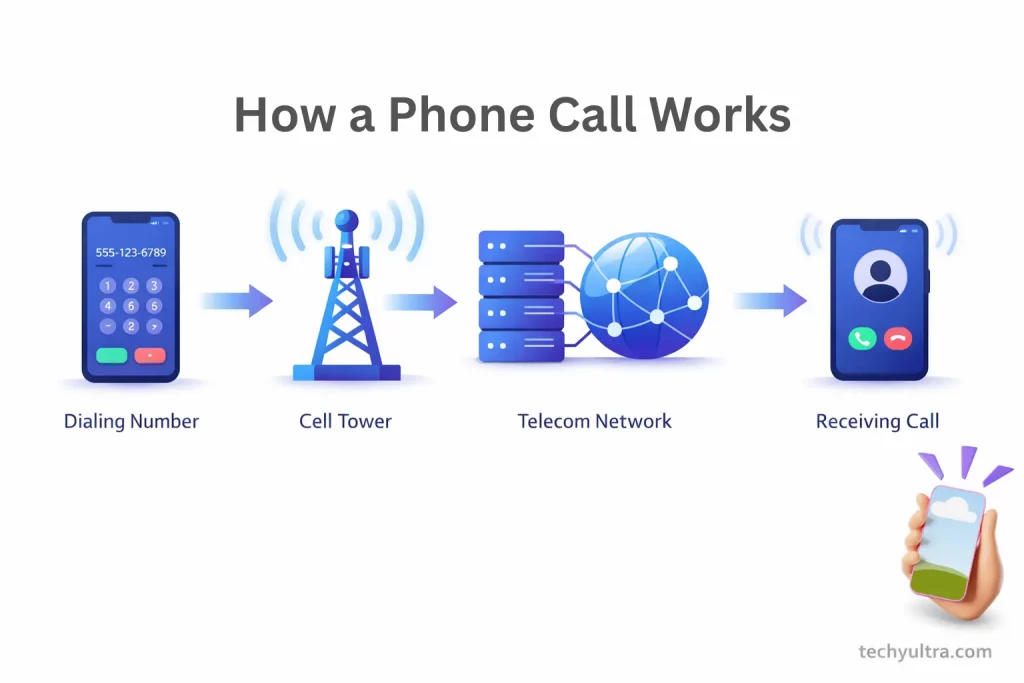
What Happens the Moment You Dial a Number
Let’s start right at the beginning, the tap of a button. The moment you dial a number, your phone doesn’t just “call” the person directly. It first reaches out to the nearest cell tower to announce itself and request a channel. Think of it like raising your hand in a crowded room to say, “Hey, I need to make a call.”
Your phone encodes the number you dialed and sends it as a digital signal usually over a control channel, which is separate from the actual voice channel. The tower picks that up and forwards it to what’s called a Base Station Controller (BSC), which manages a cluster of towers in your area. The BSC then passes it to a Mobile Switching Center (MSC), and this is where the telephone call process starts to get interesting.
The MSC is basically the brain of the operation, it figures out where the person you’re calling is located (which network, which region), and starts building a path to get your voice there. If they’re on the same network, it’s relatively clean. If they’re on a different carrier, the call gets handed off between networks through interconnect agreements. This all happens in a matter of seconds.
How the Network Locates the Receiver
Your phone doesn’t just go silent between calls. It’s quietly checking in with nearby towers the whole time, registering its location so the network can find it when someone calls, even when you’re not on a call. Your phone periodically “pings” the nearest towers to register itself, a process called location registration. When someone calls you, the network checks a database (called the Home Location Register, or HLR) to find which MSC you’re currently registered under, and routes the call there.
If you’re roaming in another country, a visitor location register (VLR) temporarily holds your info, and the two databases communicate to connect the call. It’s actually a pretty elegant system when you understand it, your phone is constantly whispering to the network, “I’m here, I’m here,” so calls can find you.
How Mobile Networks Work: Towers, Stations, and Switching Centers
Understanding how mobile networks work requires thinking in layers. What you see is the tall towers on hills or rooftops, is just the tip of it. Each tower (more accurately called a Base Transceiver Station, or BTS) covers a “cell” a geographic area. Cities have smaller, overlapping cells everywhere. Rural areas have much larger ones, which is why signal gets thin fast when you drive through countryside.
Several BTS units connect to a Base Station Controller (BSC). The BSC handles radio resource management, basically deciding which frequencies get used, managing handoffs when you move between cells, and keeping the connection stable while you’re in motion. Ever been on a call in a car and the voice got choppy for a second? That’s often a handoff happening, your call getting transferred from one tower to another mid-conversation.
Above the BSC sits the Mobile Switching Center, which connects to the public telephone network (PSTN) and other carriers. The MSC is where calls get routed, billed, and in some setups, recorded (legally, for things like customer service lines). In modern 4G and 5G networks, a lot of this switching happens in software rather than dedicated hardware, which makes it faster and more scalable.
How Mobile Phone Calls Work Behind the Scenes
This is the part that genuinely blew my mind when I first learned it. Your voice, the thing that makes you sound like you — is analog. It’s waves in the air, vibrations, frequencies. But the moment it enters your phone’s microphone, it gets converted into a digital signal almost instantly.
Your phone’s codec (short for coder-decoder) samples your voice thousands of times per second and converts those samples into binary data 1s and 0s. The exact codec depends on the network and technology generation. GSM networks traditionally used codecs like AMR (Adaptive Multi-Rate), while newer VoLTE calls use codecs like EVS (Enhanced Voice Services), which gives noticeably better audio quality.
That digital data gets compressed, broken into packets, and sent from your phone to the nearest tower. The tower relays it up the chain – to the BSC, then the MSC, then (if needed) across fiber optic lines, satellite links, or internet infrastructure depending on the route. On the other end, the receiver’s phone does the reverse: reassembles the packets, decodes them, and converts the signal back into the sound of your voice through their speaker.
This whole process is digitizing, compressing, transmitting, reassembling, and playing back, happens continuously in real time, many times per second. It’s honestly remarkable that it works as well as it does.
What Happens When the Other Person Picks Up
While your phone is ringing on the other end, the network is holding open a kind of “reserved path” between you and the receiver. When they answer, a confirmation signal travels back through the network and now a two-way voice channel is fully established. This is called connection establishment, and it’s the moment billing typically starts on carrier systems.
Once connected, your voices travel simultaneously in both directions like what engineers call full-duplex communication. This is different from walkie-talkies (half-duplex), where only one person can talk at a time. On a phone call, you can both speak and be heard at the same moment, even if it sometimes causes awkward interruptions.
The network maintains this open channel for the duration of the call, continuously managing signal quality, adjusting power levels on your phone, and handling any tower handoffs if you’re moving. When one of you hangs up, a termination signal is sent, the channel is released, and the resources go back into the pool for someone else’s call.
Voice Call Technology: From 2G to 5G
Not all calls are created equal, and the generation of network you’re on makes a big difference in how your call sounds and behaves. Here’s a quick breakdown of how the technology has evolved.
2G and 3G: The Old Guard
2G (GSM) networks used circuit switching for voice calls, meaning a dedicated circuit (basically a fixed pathway) was reserved between you and the caller for the entire duration of the call. No sharing, no flexibility. It worked, but it wasn’t efficient, and call quality was limited.
3G improved data speeds and introduced better compression, but voice calls still largely relied on the same circuit-switched model underneath. The audio quality got a bit better with improved codecs, but the fundamental architecture wasn’t that different.
4G VoLTE: The Game Changer
Voice over LTE (VoLTE) was a genuine leap forward. Instead of circuit switching, VoLTE sends your voice as data packets over the 4G LTE network, the same network your streaming and browsing use. This means calls connect faster (noticeably so), audio quality is significantly better (HD voice), and your phone can use LTE for data at full speed while you’re on a call.
If you’ve ever noticed that older phones would drop to 3G the moment you got a call, that’s because their hardware couldn’t handle voice and data on 4G simultaneously. VoLTE solved that. Most modern smartphones support it, and most carriers now default to it when available.
5G Calling: Still Evolving
5G voice calling (sometimes called Voice over NR, or VoNR) works similarly to VoLTE but on the 5G network. In practice, most carriers still rely on 4G VoLTE for voice even when you’re in a 5G area, because 5G coverage isn’t universal enough yet to handle voice reliably everywhere. True 5G voice is coming and when it’s fully deployed, expect even lower latency and better quality but for now, your phone probably falls back to VoLTE for most calls.
Why Calls Drop or Sound Terrible Sometimes
Alright, the frustrating part. Dropped calls are one of those things that shouldn’t happen anymore and yet here we are. There are a few main culprits.
Weak signal is the most obvious one. If you’re too far from a tower, in a basement, or surrounded by thick concrete walls, your phone can’t maintain a stable connection. Urban environments actually have a different problem like too many walls, glass panels, and interference from other electronics all degrade signal indoors even when you’re technically close to a tower.
Tower congestion is another big one that people overlook. Cell towers have a limited number of channels they can handle simultaneously. During peak hours, major events, or emergencies when thousands of people in the same area try to call at once, towers get overwhelmed. That’s why you sometimes can’t get a call through at midnight on New Year’s Eve.
Network handoffs are less of a problem with modern systems, but still cause occasional drops. When you’re moving, driving, walking, on a train your call gets handed from tower to tower. Most of the time this is seamless. Occasionally, especially at the edge of coverage or between network types (say, from 4G to 3G), the handoff fails and the call drops. This is more likely to happen in fringe areas where towers are far apart.
One thing worth knowing: if you’re on a call and the audio gets choppy but the call doesn’t drop, that’s usually packet loss, some of the voice data packets didn’t make it in time and the codec is filling in the gaps as best it can. Better codecs like EVS handle this much more gracefully than older ones.
Frequently Asked Questions
-
Can calls be intercepted mid-air?
Old 2G calls? Yeah, pretty easily because the encryption was weak. Modern 4G and 5G calls are much harder to tap in real time. If law enforcement needs access, it happens at the network level through legal channels, not by pulling signals out of the air.
-
Why does international calling work differently?
Because it is. Your voice is traveling through undersea cables or satellite links before it even hits the destination country’s network. More distance, more routing, slightly more latency. Apps like WhatsApp skip all of that by just using internet data directly.
-
How is a Wi-Fi call different from a regular cell call?
Yes. Instead of going through a cell tower, your voice travels over your home internet connection to your carrier’s servers. Same number, same experience, just a different route. Really useful when you’re indoors with bad cell signal but decent Wi-Fi.
-
Does airplane mode actually prevent all signals?
The cellular radio, yes completely. Wi-Fi and Bluetooth get switched off too, but you can turn those back on manually. The cellular part stays off because it actively hunts for towers, which is the bit that can interfere with aircraft systems.
-
How long does it take for a call to connect?
Authentication, routing, back-and-forth signaling between networks. On VoLTE it’s usually 2–3 seconds. On older networks or weak signal, closer to 5–10. Feels instant most of the time, which honestly says a lot about how well the infrastructure is built.

Hi, I’m Aditya Sharma, a BSc in Radiology student and founder of Techy Ultra, a tech blog covering AI tools, Android tips, blogging, online earning, digital tools, useful apps and software tips & tricks. I have a self-taught background in tech field and like to share information from this blog.