If you’ve been blogging for a while, you’ve probably felt this frustration at least once. You spend hours researching, writing, editing, and hitting publish only to watch one article randomly take off while another stays indexed but not ranking on Google. It feels inconsistent, and honestly, a little discouraging.
I went through the same phase. For a long time, I thought better writing alone would fix it. But eventually, I realized the problem wasn’t effort, it was structure. That’s when I came across the idea of a pillar post in blogging, and it completely changed how I approached content and SEO.
At first, the term sounded overly technical, almost like something only SEO experts talk about. But once I actually understood it, everything clicked. In this article, I’ll explain pillar posts in plain language, without unnecessary jargon. By the end, you’ll know exactly what a pillar post is, why it matters, and how to use it in a way that supports long-term growth rather than quick wins.
Blogging Has Changed (And That’s Why Pillar Posts Matter)
A few years ago, blogging was mostly about writing individual articles, optimizing them for a keyword, and hoping Google would rank them. That approach can still work, but it’s no longer enough, especially in competitive niches.
Search engines today care deeply about topic authority, especially if your goal is to rank a website on Google consistently rather than relying on one-off posts. Google wants to know:
- Do you deeply understand this topic?
- Do you cover it completely?
- Can users trust your content?
This is exactly where pillar content in blogging comes into play.
Instead of treating each blog post as a standalone piece, pillar-based blogging organizes content into valid clusters. At the center of that cluster is one strong, authoritative article the pillar post.
What Is a Pillar Post? (Explained Without SEO Jargon)
So, what is a pillar post in the simplest terms?
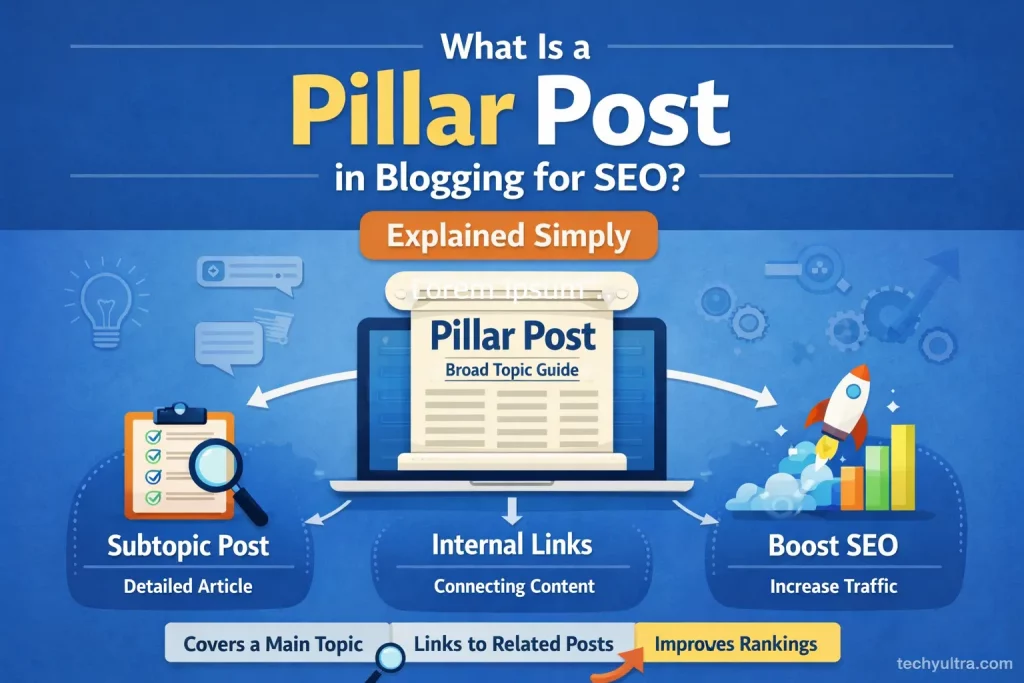
A pillar post is a long, in-depth article that covers a broad topic comprehensively, while linking to more detailed articles that explain specific subtopics.
Think of it like this:
- The pillar post is the main book.
- Supporting blog posts are individual chapters.
The pillar post doesn’t go extremely deep into every detail, but it gives a solid overview and guides readers to more focused content when needed.
This is the core pillar post meaning:
A central, authoritative piece of content that acts as the foundation of a topic on your blog.
Why a Pillar Post in Blogging Is So Powerful for SEO
From an SEO point of view, pillar posts quietly do a lot of heavy lifting. They’re not flashy, and they don’t always bring instant results, but over time they change how search engines see your entire site.
Here’s what I’ve personally noticed after building content around pillar posts:
- Internal linking starts to make sense
Instead of forcing links wherever possible, everything connects naturally. Supporting posts link back to the pillar, and the pillar guides readers deeper. It feels intentional, not mechanical. - You stop chasing single keywords
One strong pillar post can help you rank for dozens of related searches. You’re no longer dependent on one exact phrase performing well. - Readers stick around longer than you expect
When someone lands on a pillar post and finds clear explanations with relevant links, they don’t bounce immediately. They explore, and that behavior sends positive signals to Google. - Your best content doesn’t expire quickly
Unlike trend-based posts, a pillar article can be updated, expanded, and improved over time. Some of your best traffic can come from content you wrote months or even years ago.
Pillar posts rarely explode overnight. But once they start ranking, the traffic tends to be steady and predictable, and that’s far more valuable in the long run.
Pillar Content in Blogging vs Regular Blog Posts
Let’s clear up a common confusion.
Not every long blog post is pillar content in blogging.
Here’s the difference:
| Regular Blog Post | Pillar Post |
|---|---|
| Focuses on one narrow topic | Covers a broad topic |
| Targets one main keyword | Targets a topic cluster |
| Can stand alone | Connects multiple articles |
| Often short or medium length | Usually long-form (2,000+ words) |
A pillar post is more strategic. It’s not written just to publish, it’s written to anchor your entire content strategy.
Real-Life Pillar Post Examples (So It Clicks Instantly)
Sometimes examples make everything clearer. Here are a few pillar post examples from common blogging niches:
Example 1: Fitness Blog
- Pillar Post: “The Complete Beginner’s Guide to Weight Loss”
- Supporting posts:
- How Calories Work
- Cardio vs Strength Training
- Healthy Meal Planning
- Common Weight Loss Mistakes
Example 2: Tech Blog
- Pillar Post: “The Ultimate Guide to Smartphones in 2026”
- Supporting posts:
- Best Budget Smartphones
- Smartphone Camera Comparison
- Android vs iOS Explained
- How to Choose a Smartphone
Example 3: Blogging Niche
- Pillar Post: “The Complete Guide to Blogging for Beginners”
- Supporting posts:
- How to Start a Blog
- SEO Basics for Bloggers
- How to Monetize a Blog
- Content Writing Tips
Each of these pillar post examples shows how one strong article becomes the center of an entire content ecosystem.
How to Create a Pillar Post in Blogging (Step by Step)
Let’s get practical. Here’s a simple, real-world process you can actually follow.
1. Choose a Topic You Want to Be Known For
Ask yourself:
- What topic do I want Google to associate with my site?
- What do I already write about or plan to write about consistently?
Your pillar topic should be broad but relevant to your niche.
2. Research Subtopics (Not Just Keywords)
Instead of focusing only on keywords, think in terms of questions and problems:
- What does a beginner want to know?
- What confuses people most?
- What do they search next?
These become your supporting articles.
3. Write the Pillar Post First (Yes, First)
I did exactly that for months, and it left my blog feeling scattered. I’ve learned it’s much easier to do the opposite.
One example still makes me cringe a little. Before I understood pillar content, I wrote a post called “Best Blue Pens for Students”. I spent time researching, added images, optimized it for a keyword and it got almost no traffic for months. There was nothing linking to it, nothing supporting it, and no clear reason for Google to treat it as important. Looking back, it wasn’t a bad article. It was just isolated.
Your pillar post should:
- Explain the topic clearly
- Use real-life examples
- Link naturally to deeper articles
- Avoid fluff but still feel human
4. Internally Link Like a Human, Not a Robot
Link only when it makes sense for the reader.
Avoid forced links or exact-match anchor text everywhere. Google is smart and so are readers.
How Long Should a Pillar Post Be?
There’s no magic number, but most successful pillar posts are:
- 2,000 to 4,000 words
- Well-structured
- Easy to scan
- Updated regularly
Length alone doesn’t matter. Clarity and usefulness do.
EEAT: Why Pillar Posts Naturally Align With Google’s Guidelines
Google’s EEAT framework (Experience, Expertise, Authoritativeness, Trustworthiness), explained in Google’s helpful content guidelines, is often misunderstood. A well-written pillar post in blogging naturally supports all four.
- Experience: You share real insights, mistakes, and lessons.
- Expertise: You cover the topic in depth.
- Authoritativeness: Interlinked content shows topical dominance.
- Trust: Clear explanations and honest tone build credibility.
Adding personal experiences like what worked for you and what didn’t, makes a huge difference here.
Common Mistakes to Avoid
Even good bloggers mess this up sometimes. Here are a few pitfalls to watch out for:
- Writing a pillar post that’s too shallow
- Targeting too many unrelated topics
- Over-optimizing with keywords
- Forgetting to update old pillar content
- Treating pillar posts like one-time projects
A pillar post is a living asset, not a “publish and forget” article.
Does Every Blog Need Pillar Posts?
Honestly? Not always.
If you’re running a personal journal or a very small hobby blog, you might not need a full pillar strategy. But if your goal is:
- Organic traffic
- Authority
- Monetization
- Long-term growth
Then yes, pillar posts are worth the effort.
Why Pillar Posts Are Worth Your Time
A pillar post in blogging isn’t just another SEO trick. It’s a mindset shift. Instead of chasing random keywords, you focus on building something useful.
When I started structuring my content around pillar ideas, my blog felt more organized, my writing had more direction, and most importantly, my traffic became more stable.
If you take one thing away from this article, let it be this:
Write for humans first, structure for search engines second. Pillar posts allow you to do both beautifully.
If you’re serious about blogging in 2026 and beyond, understanding what is a pillar post and applying it correctly might be one of the smartest moves you make.

Hi, I’m Aditya Sharma, a BSc in Radiology student and founder of Techy Ultra, a tech blog covering AI tools, Android tips, blogging, online earning, digital tools, useful apps and software tips & tricks. I have a self-taught background in tech field and like to share information from this blog.