If you’ve been phone shopping lately and something feels off either the prices seem higher than they should be, or you’re seeing 4GB RAM phones creeping back into segments where 8GB was the norm, you’re not imagining it. The smartphone market is quietly going backwards right now, and the root cause isn’t inflation or supply chain drama from a pandemic. This time, it’s AI.
The RAM shortage of 2026 is a real, ongoing supply crisis that’s quietly making its way from data centers in Silicon Valley all the way to the budget phone aisle at your local Croma or Vijay Sales. And if you’re planning to buy a new Android phone this year, especially in the ₹10,000–₹30,000 range, you need to understand what’s happening before you spend your money.
After tracking smartphone launches, pricing trends, and hardware changes across Indian markets for the past couple of years, the current RAM situation stands out as one of the biggest shifts in recent times.
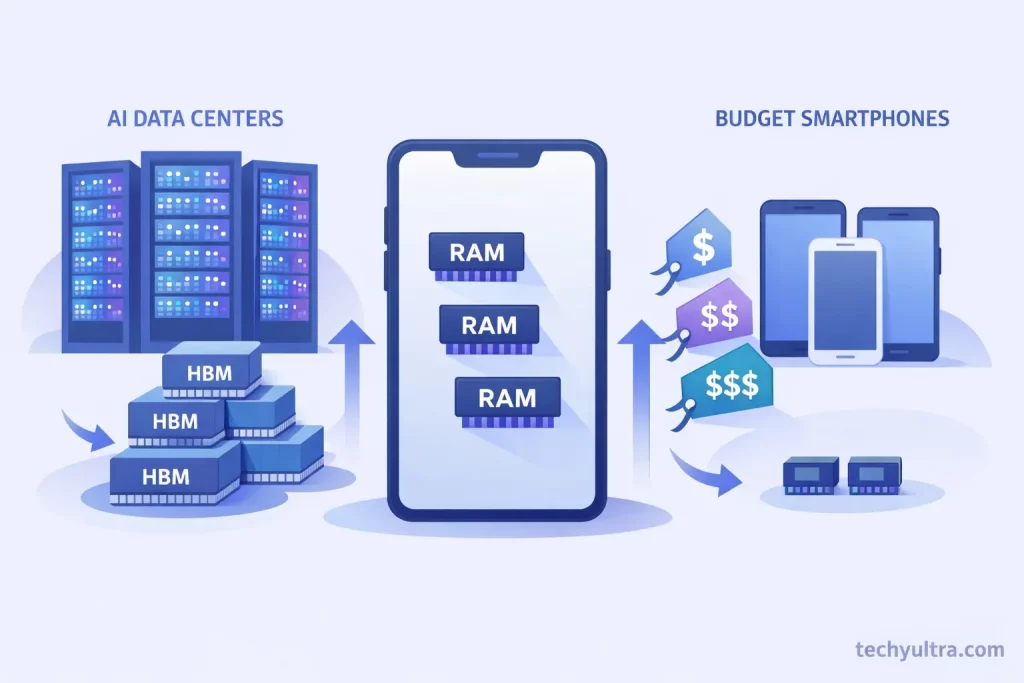
What is RAM, and Why Does It Even Matter?
Quick version for anyone new to this: RAM (Random Access Memory) is your phone’s short-term working memory. It’s not where your photos are stored, that’s internal storage. RAM is what your phone uses to run apps right now. When you’re switching between WhatsApp, Chrome, YouTube, and Instagram, your phone is juggling all of that in RAM.
More RAM means smoother multitasking, fewer app reloads, and a generally snappier experience. With less RAM, you’ll notice apps reloading every time you switch back to them, or the phone slowing down when you have a few things open. It gets frustrating fast. I wrote more about this in my earlier article on why smartphones feel slower over time, that piece covers RAM’s role in long-term phone performance in more detail.
What’s Causing the Global RAM Shortage of 2026?
RAM is specifically the type called DRAM which is manufactured by basically three companies: Samsung, SK Hynix, and Micron. That’s it. Together, these three control over 95% of global DRAM production. Every LPDDR5 chip inside your Redmi phone, every memory module in your laptop, it almost certainly came from one of these three.
The way DRAM is made involves extremely specialized factories called fabs (fabrication plants), and the key resource inside a fab is silicon wafer capacity. You can only process so many wafers at a time, and every wafer you use for one product is a wafer you can’t use for another. It’s a zero-sum game.
And this is where it gets messy for phone buyers. AI data centers such as ChatGPT, Google Gemini, and literally every large AI model you’ve heard of need a different, more advanced kind of memory called HBM (High Bandwidth Memory). HBM is like regular RAM’s overachieving cousin: faster, more powerful, and dramatically more profitable for manufacturers to sell. To produce a single gigabyte of HBM, manufacturers must consume roughly three times the raw silicon wafer capacity required for the phone-grade DRAM.
Think of it like a hospital pharmacy that used to fill prescriptions for regular patients all day. Then a government contract comes in — bulk orders, guaranteed payment, higher margins. The pharmacy shifts most of its staff to fulfilling that contract. Walk-in patients wait longer. Prices for the counter drugs creep up. The pharmacy didn’t turn evil. It just followed the money.
AI data centers now consume an estimated 70% of all memory chips produced worldwide. Companies like Microsoft, Google, Meta, and Amazon are essentially outbidding every smartphone manufacturer for access to wafer capacity. And Samsung, SK Hynix, and Micron are more than happy to oblige because the margins on HBM are significantly better.
Every wafer allocated to an HBM stack for an Nvidia GPU is a wafer denied to the LPDDR5X module of a mid-range smartphone. That’s not an opinion, that’s IDC, one of the most respected tech research firms in the world, describing exactly what’s happening.
The scale is hard to wrap your head around. Microsoft and OpenAI’s “Stargate” project a $100 billion supercomputer that could theoretically require 40% of the entire world’s DRAM output to function at peak capacity. That single project alone is reshaping the global memory supply chain.
How Bad Is It? The Numbers Are Uncomfortable
This isn’t a “prices might go up a little” situation. Prices for both DRAM and HBM chips have hit record highs, nearly doubling in the first quarter of 2026 compared with the previous quarter. Doubled. In one quarter.
For low-end smartphones priced below $200, the bill of materials cost has increased 20% to 30% since the beginning of the year, according to Counterpoint Research. That cost increase has to go somewhere and it’s going into either higher prices for you, or less RAM in the phone.
The most affected segment is the low-end smartphone market, where base models are likely to return to 4GB RAM in 2026. TrendForce, another major industry research firm, has said this outright. Four gigabytes. In 2026. On phones that were comfortably at 6GB or 8GB just last year.
The mid-range isn’t safe either. Premium smartphones with 16GB of RAM could become virtually extinct in 2026, with even high-end devices likely to stick with 12GB rather than increasing capacity. And for budget Android brands specifically, Xiaomi budgeted for a roughly 25% increase in DRAM expense per phone in its 2026 model year.
IDC estimates that the average selling price of smartphones will rise 14% this year to an all-time high of $523. That’s the global average. In India, where buyers are price-sensitive and the budget segment dominates, the impact will be disproportionate.
The different smartphone price segments:
| Segment | 2024 RAM | 2026 Trend | What It Means |
|---|---|---|---|
| Budget (<₹15K) | 6GB–8GB | 4GB–6GB | Slower multitasking, more app reloads |
| Mid-range (₹15K–₹30K) | 8GB–12GB | 6GB–8GB | Higher prices or reduced specs |
| Premium (>₹40K) | 12GB–16GB | 12GB | Less upgrade, but stable performance |
What This Means for Indian Phone Buyers Specifically
India is the world’s second-largest smartphone market, and the bulk of that market lives in the ₹8,000–₹25,000 price bracket. That’s exactly where this shortage hits the hardest.
The budget segment (under ₹15,000) is facing the worst of it. The phones that sell in this range is Redmi 14C, Realme C series, Narzo variants are extremely sensitive to component costs. At these price points, manufacturers are already operating on thin margins. When RAM costs jump 20–30%, something has to give. You’re already seeing signs of it: phones in this range are quietly launching with 4GB RAM base variants again, storage configs are being tweaked, and the generous “6GB+2GB virtual RAM” tricks are being pushed harder in marketing to disguise what’s happening.
Mid-range buyers in the ₹20,000–₹35,000 range aren’t escaping either. A phone that would have launched at ₹22,999 with 8GB RAM last year might now come in at ₹25,999, or launch at the same price with 6GB. The Poco X series, Redmi Note series, Realme GT these are the phones most affected in this tier. You might not notice the change immediately in the spec sheet, but you’ll notice it when you actually use the phone a year down the line.
The premium segment (₹40,000+) is more insulated. Among the three market segments, the premium segment above $600 is best positioned to absorb the rising costs from the RAM shortage, since flagship smartphones command higher profit margins. So if you’re buying a Samsung Galaxy S25 or a OnePlus 13, you’re relatively safer, though even there spec upgrades are being quietly skipped.
Based on current pricing trends and recent launches, here’s my honest take – if I were buying a phone right now with a budget under ₹20,000, I would not wait. I’d buy a current-generation phone today, even if it means grabbing a slightly older model on discount. The RAM situation in this segment is going to get worse before it gets better, and waiting six months will likely give you either the same specs at a higher price, or worse specs at the same price. That’s not speculation, that’s what the supply chain data is pointing toward.
One more thing specific to India: as new 2026 midrange models revert to lesser RAM and lose their premium features, value-minded buyers will realize that a refurbished 2024 flagship offers a more compelling option. This is genuinely worth considering. A refurbished OnePlus 12 or Samsung Galaxy S23 FE right now might be a better buy than a brand-new budget phone in Q3 2026.
Should You Buy a Phone Now or Wait?
Under ₹15,000: Buy now. This segment will see the worst spec downgrades as the year progresses. Budget phones launching in the second half of 2026 are likely to have 4GB RAM, slower storage, and higher price tags than what’s available today. If you need a phone in this range, buying a current-gen device right now is the smarter move.
₹15,000–₹30,000: Buy now if you genuinely need a phone. If you can wait 4–6 months without pain, then wait but only because there’s a possibility prices stabilize slightly toward late 2026. Don’t wait expecting better specs at the same price. You won’t get that. You’re waiting for prices to stop rising, not fall.
₹30,000 and above: This segment is more flexible. Flagships are better insulated from the shortage, so you have more room to wait for a phone you specifically want. However, don’t expect the usual year-over-year spec jump, the upgrade from 12GB to 16GB RAM on flagships may simply not happen this cycle.
When you are buying, here’s what to prioritize right now:
- Get at least 8GB RAM. 6GB is the absolute floor for a smooth Android 14/15 experience, but 8GB gives you breathing room.
- Don’t compromise on storage type. UFS 3.1 or UFS 4.0 storage makes a real difference in daily performance, especially on budget phones where RAM is being cut.
- Check when the phone launched. A phone from mid-2024 might have better RAM specs than a brand-new phone launching in late 2026. Don’t assume new = better this year.
When Will the RAM Shortage End?
Not anytime soon and the numbers back that up.
Micron’s massive new fab in Idaho won’t be operational until 2027, and their Hiroshima facility won’t produce its first output until 2028. Samsung’s expansions are giving absolute priority to HBM and enterprise DRAM through 2027. New fabs take 2–3 years to build and qualify. There’s no shortcut.
Meaningful price relief may not arrive until closer to 2028, according to some analyst estimates and even that depends on AI demand not continuing to accelerate. Given what we’re seeing with each new AI model launch, that’s not a safe assumption.
The more realistic scenario is a gradual stabilization toward late 2026 or early 2027, not a dramatic price drop, but a point where costs stop rising as fast. Analysts and tech executives have warned that the memory shortage will persist well into next year. Don’t hold your breath waiting for RAM prices to suddenly crash. Plan your phone purchase around current realities, not a hoped-for recovery.
Making the Most of Less RAM — Practical Tips
If you’re on a phone with 4GB or 6GB RAM, or you’re about to buy one, here’s how to actually squeeze performance out of it.
Check what’s using your RAM. On Android, go to Settings → About Phone → tap “Build Number” 7 times to enable Developer Options → then go to Developer Options → Running Services. This shows you exactly which apps are sitting in the background eating memory. You’ll often find 3–4 apps you haven’t opened in weeks still running.
Kill the RAM hogs. Facebook, Snapchat, TikTok, and surprisingly Google Chrome are notorious for holding large chunks of background memory. If you use Facebook, consider switching to the mobile browser version instead of the app, it’s lighter and doesn’t run persistent background processes.
Disable pre-installed bloatware. Budget Redmi and Realme phones ship with a fair amount of pre-installed apps you’ll never use. Go to Settings → Apps → find anything you don’t use, and hit Disable (you may not be able to uninstall, but disabling stops it from running). Even disabling 4–5 unused apps can meaningfully free up RAM.
Keep your phone’s software updated. This sounds obvious, but MIUI, Realme UI, and ColorOS have improved significantly at RAM management in their recent versions. Keeping your UI updated often gives you noticeably better multitasking performance on the same hardware.
Restart your phone once a week. A clean reboot clears accumulated memory fragmentation and cached processes. Budget phones especially benefit from this.
None of this replaces having more RAM. But when the market gives you fewer options, squeezing every bit of performance from what you have is genuinely worthwhile.
Frequently Asked Questions
What is causing the RAM shortage in 2026?
The core cause is AI data centers consuming enormous amounts of high-bandwidth memory (HBM). The same manufacturers who make phone RAM, Samsung, SK Hynix, and Micron have shifted their production capacity toward HBM because it’s more profitable, leaving less supply for smartphones and consumer electronics.
Will phone prices increase because of the RAM shortage?
Yes, and it’s already happening. Budget and mid-range phones in India are being affected most. Expect either higher prices for the same specs, or the same price with reduced RAM particularly in the ₹8,000–₹25,000 range.
Which phone brands are most affected by the smartphone RAM crisis?
Budget-focused brands like Redmi, Realme, and Poco are the most exposed because their margins are thin and RAM is a significant part of their bill of materials. Premium brands like Apple and Samsung flagship lines have better negotiating power with suppliers and higher margins to absorb cost increases.
Is 4GB RAM enough for a smartphone in 2026?
Technically, no. Android 14 and 15 with Google’s baseline requirements can run on 4GB, but real-world multitasking gets painful. Six gigabytes is the practical minimum for a smooth experience, and 8GB is what I’d recommend if you’re buying a phone you plan to use for 2–3 years.
When will the RAM shortage end?
Industry estimates lean toward late 2026 at the earliest for any meaningful stabilization, with genuine price relief potentially not arriving until 2027 or even 2028. New manufacturing capacity being built right now won’t come online for another 2–3 years.
The broader pattern here is worth noting beyond just phone prices. We’re living through a moment where consumer technology is being deprioritized in favor of AI infrastructure at a structural level not because phone makers want it this way, but because the economics of HBM are just too attractive for memory manufacturers to resist. For most of us, this means getting used to an era where last year’s phone is often a better buy than this year’s, and where “new” doesn’t automatically mean “better specs.”
In a market like India where ₹2,000 is the difference between two entirely different phones, this matters more than anywhere else.
Buy smart. Check the RAM. And maybe hold onto that phone you already have for just a bit longer than you planned.

Hi, I’m Aditya Sharma, a BSc in Radiology student and founder of Techy Ultra, a tech blog covering AI tools, Android tips, blogging, online earning, digital tools, useful apps and software tips & tricks. I have a self-taught background in tech field and like to share information from this blog.