Last year I installed a flashlight app that asked for access to my contacts and microphone, etc. I ignored it and tapped Allow without thinking. That was the moment I started paying more attention to what free apps actually ask for and why.
The next morning, my phone battery was draining faster than usual. A week later, random ads started popping up in places they never used to. That tiny flashlight app had access to my contacts, storage, and even location. For a simple light.
Back then, I laughed it off. Today, I don’t. I didn’t even check what permissions it asked for. I just assumed “flashlight” meant harmless. That assumption was my mistake.
Because if you look closely, you’ll notice something uncomfortable: Why free apps are becoming dangerous isn’t a conspiracy theory anymore. It’s a pattern.
And it’s increasing every year.
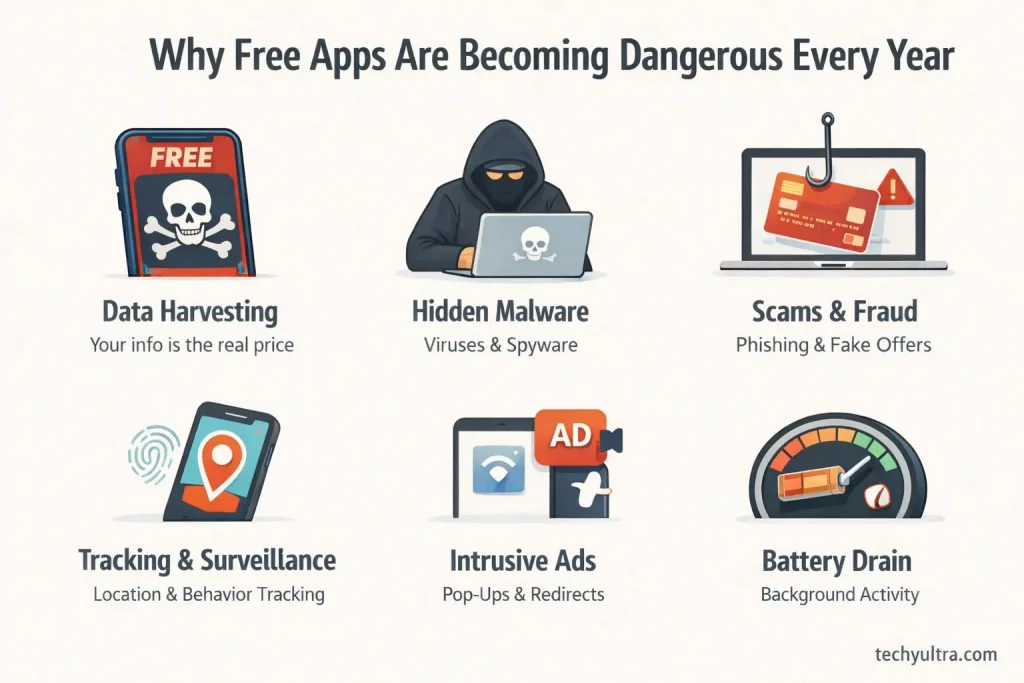
The Illusion of “Free”
There’s a simple rule in business: nothing is free. If you aren’t paying with money, you’re paying with something else.
Most of us understand this in theory. But in practice, we still tap “Accept” without reading anything.
When an app says free, it often means:
- You are the product
- Your data is the currency
- Your attention is the commodity
That might sound dramatic, but it’s not. It’s basic economics.
For developers, servers cost money. Engineers cost money. Marketing costs money. So when an app has no visible price tag, the question naturally becomes: How free apps make money?
Tools comparison also matters when choosing software you trust, see Best Free Software for College Students to Help With Studies for examples of reputable free tools.
How Free Apps Make Money (And Why It Matters)
There are several revenue models, and not all of them are evil. But some are getting more aggressive every year.
1. Advertising on Steroids
Most free apps rely on ads. That’s normal. What’s changed is how ads are targeted.
Apps now collect behavioral data like what you search, how long you pause on a video, where you move, which Wi-Fi networks you connect to. This data feeds into ad networks that build frighteningly detailed profiles.
It’s no longer “show sports ads to sports fans.”
It’s “show high-interest loan ads to someone who searched about debt at 2 AM.”
The more data an app collects, the more valuable you become.
2. Data Brokerage (The Quiet Industry)
Some apps share anonymized data with third parties. But anonymized data isn’t always truly anonymous. Combine enough data points, and patterns emerge.
Location + device ID + browsing behavior = identity.
That’s where serious Free apps privacy risks begin.
3. Freemium Pressure
Free to install. Pay to unlock. That model sounds fair.
But some apps deliberately design frustration. They slow progress, restrict features, or bombard you with ads until you feel forced to upgrade.
It’s not illegal. But it’s manipulative design psychology.
4. Selling Behavioral Insights
Some companies don’t sell your raw data. They sell insights derived from it. Market trends. Consumer behavior clusters. Spending probability models.
It’s more abstract, but the source remains you.
Why Free Apps Are Becoming Dangerous in Subtle Ways
The danger isn’t always obvious like malware. It’s quieter now. Smarter.
Let’s look at how things evolved.
1. Permissions Have Expanded
A calculator asking for contact access used to be a red flag. Today, many users don’t even question it.
Apps request permissions under the excuse of “improving user experience.” And sometimes that’s true. But sometimes it’s excessive.
Microphone access.
Precise location.
Background activity.
You might never use those features, but the app still has them.
2. Data Breaches Are Increasing
Even if an app isn’t malicious, it can still be insecure.
When small developers collect massive amounts of user data but don’t invest properly in security, that creates a ticking time bomb.
Take the 2024 ‘Mother of All Breaches’ (MOAB), which exposed 26 billion records. Even if your ‘free’ app wasn’t the target, if they used a weak SDK, your data could have been part of that leak. The more data stored, the bigger the risk. That’s where Free apps security risks become real-world consequence, leaked emails, phone numbers and passwords.
And once data is out, it never truly comes back.
3. The Rise of Fake and Clone Apps
Open app stores are a blessing and a curse. While companies like Google and Apple invest heavily in moderation, fake apps still slip through.
Some are harmless copies. Others are phishing traps.
You think you’re installing a banking tool. It’s actually harvesting login credentials. In fact, security researchers regularly report clone versions of popular apps appearing on app stores for short periods before being taken down. Sometimes they last just long enough to trap thousands of users.
These scams are getting more sophisticated, using nearly identical names, icons, and screenshots.
Are Free Apps Safe to Use?
This is the question everyone asks.
The honest answer: Some are. Some aren’t.
Blanket statements don’t help.
Big-name platforms like Meta or TikTok are free. They’re not secretly stealing passwords. But they do operate on large-scale data monetization models.
So the question shifts from “Are free apps safe to use?” to:
“What am I comfortable trading for convenience?”
Safety now exists on a spectrum:
- Malware risk
- Privacy risk
- Psychological manipulation
- Financial exploitation
Not every app hits all four. But many hit at least one.
The Psychological Side No One Talks About
There’s another layer that makes the topic of why free apps are becoming dangerous more complex.
Behavior design.
Free apps often use:
- Infinite scrolling
- Variable reward systems
- Social validation triggers
These aren’t accidents. They’re deliberate.
The longer you stay, the more ads you see.
The more you engage, the more data you generate.
It’s not just about privacy anymore. It’s about attention engineering.
Over time, that affects productivity, mental health, and even relationships.
This isn’t paranoia. Former tech insiders have openly discussed persuasive design frameworks used inside major companies.
Free apps aren’t just tools anymore. They are behavioral ecosystems.
In my experience, “phone cleaner” and “battery booster” apps are usually the worst offenders. Most modern smartphones don’t even need them.
The Darker Edge: Malware Hidden in Plain Sight
In late 2025, Google purged apps like ‘AquaTracker’ and ‘Scan Hawk’ which had millions of installs. These weren’t just ‘buggy’, they were part of the ‘Vapor Operation,’ a massive ad-fraud scheme that bypassed Android 13 security to drain user batteries and steal data.
They behave normally for weeks to avoid detection. Then they activate malicious features:
- Spyware
- Cryptocurrency mining
- Ad fraud bots
Because these apps are free and easy to download, they spread quickly.
The more relaxed users become about permissions, the easier this becomes.
Why Things Are Getting Worse Every Year
Technology evolves fast. Regulation evolves slowly.
Developers now have access to:
- Advanced data analytics
- AI-driven user profiling
- Cross-app tracking systems
Meanwhile, users still rely on gut instinct.
And in many countries, privacy laws are inconsistent or poorly enforced.
The digital gold rush isn’t slowing down. Data is the new oil. The difference is, you don’t even know when it’s being drilled.
My Personal Rulebook for Installing Free Apps
I’m not anti-free apps. I use plenty. But I’ve developed some non-negotiable habits.
First, I ask myself: Do I really need this app?
Second, I check permissions before installation. If a wallpaper app wants microphone access, that’s a no.
Third, I read negative reviews first, not five-star ones. Real problems usually show up there.
Fourth, I avoid apps from unknown developers with no digital footprint.
And most importantly, I regularly delete apps I don’t use.
Digital minimalism isn’t trendy. It’s protective. I still mess this up sometimes. But I catch it faster now.
Free Apps Privacy Risks You Should Actually Care About
Instead of vague warnings, let’s talk specifics.
Location tracking over time can reveal:
- Where you live
- Where you work
- Your daily routine
Even anonymized data can be re-identified with enough correlation.
Contact access can expose:
- Your network
- Family relationships
- Professional connections
Storage access can expose:
- Documents
- Photos
- Screenshots
The scary part? You often grant these permissions in under five seconds.
And once granted, the data collection runs quietly in the background.
Children and Free Apps: A Growing Concern
Kids download games without understanding data policies.
Some free games collect behavioral data for targeted advertising. Others include in-app purchases designed to trigger impulsive spending.
Parents think “It’s free, so it’s harmless.”
That assumption is outdated.
The Role of AI in Amplifying the Problem
Here’s the uncomfortable truth.
AI allows apps to:
- Predict your buying behavior
- Predict emotional vulnerability
- Optimize engagement timing
If you’ve ever wondered why an ad appears right after you think about something, it’s not magic. It’s pattern analysis.
Free apps powered by AI are becoming incredibly efficient at extracting value from user behavior.
That’s not inherently evil. But it’s powerful. And power without transparency is risky.
Regulation Is Catching Up (Slowly)
Privacy regulations like GDPR have forced some accountability. But enforcement varies globally.
App stores have improved permission transparency. But users still click “Allow” automatically.
Education is lagging behind technology.
And that’s the real vulnerability.
So What Should You Actually Do?
I won’t tell you to delete every free app. That’s unrealistic.
Instead, be intentional. Be skeptical. Be aware of the trade-offs.
If an app provides real value and you’re comfortable with its data model, fine.
But stop assuming free equals harmless.
Because it doesn’t anymore.
I still use free apps. I’m not saying don’t. But I now check permissions before hitting Install, and I delete anything that seems to want more access than it needs. That habit alone has changed how I think about what’s on my phone.
Frequently Asked Questions
-
Are free apps safe to use?
Yes, if they’re from companies with a reputation to lose (like Spotify). No, if it’s a ‘Super-Fast Battery Saver’ from a developer you’ve never heard of. If the app has more ads than features, delete it immediately.
-
Why are free apps becoming more risky?
Many free apps now rely heavily on user data to make money. As competition grows, some developers use aggressive tracking, targeted ads, and persuasive design tactics. The danger isn’t always malware, it’s often privacy loss and behavioral manipulation happening quietly in the background.

Hi, I’m Aditya Sharma, a BSc in Radiology student and founder of Techy Ultra, a tech blog covering AI tools, Android tips, blogging, online earning, digital tools, useful apps and software tips & tricks. I have a self-taught background in tech field and like to share information from this blog.