When you buy a new smartphone, there’s a moment that feels almost magical. The screen glides under your finger, apps open instantly, the camera responds without hesitation, and everything feels… effortless. You remember thinking, “This is what fast really means.”
Then a few months pass.
Suddenly, animations don’t feel as fluid. Apps take an extra second to load. The same phone that once felt lightning-fast now feels just a bit tired. And that’s when the doubt creeps in: Is my phone already slowing down? Or is it just in my head?
At some point, every phone does this thing where it just… hesitates. You tap. Nothing happens. You tap again. And suddenly you’re aware you’re waiting on a slab of glass that used to feel instant.
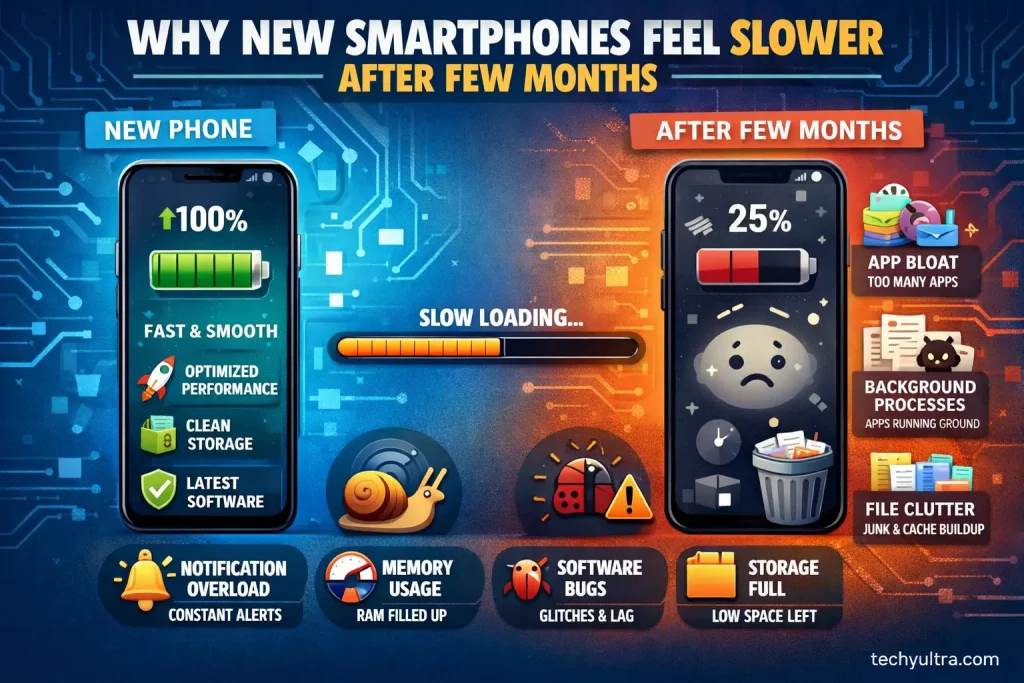
The Honeymoon Phase No One Talks About
Every new phone comes with what I like to call a honeymoon phase. Manufacturers don’t advertise this term, but it exists.
When you unbox a phone, it’s running on a clean system. No clutter, no background chaos, no behavioural history. The processor isn’t juggling dozens of learned habits yet. The battery is fresh, the storage is empty, and the system hasn’t been stressed repeatedly.
During this phase, your phone is basically living its best life, clean, unstressed, and unrealistically perfect.
That’s why people often ask, why phone fast at first then slow, because the “first” version of your phone isn’t the same device it becomes later. Not physically, but behaviorally.
Why New Smartphones Feel Slower After Few Months (The Real Reasons)
So what’s really happening under the hood? This slowdown isn’t caused by one single issue. It’s the result of multiple small changes stacking up over time.
Your Phone Learns You… and That Has a Cost
Modern smartphones are incredibly smart. Android and iOS both rely heavily on machine learning to adapt to your usage patterns. On paper, this sounds great and it is. Your phone learns which apps you open most, when you use them, how long you stay in them, and even how aggressively it should manage background tasks.
But learning comes with overhead.
Over time, without you ever agreeing to it, the system quietly builds a behavioural profile that keeps getting heavier. Background processes become more complex. Services stay active longer because the phone predicts you might need them. This adaptive behaviour quietly consumes RAM, CPU cycles, and battery resources.
So when people ask when your phone stops feeling new, this invisible learning layer is a big part of the answer.
Updates: The Double-Edged Sword
Software updates are supposed to improve things like better security, new features, bug fixes. And most of the time, they do. But the truth is updates are rarely optimized for older system states.
When your phone launched, the software was tailor-made for that hardware at that exact moment. Six months later, updates are designed for a broader ecosystem, newer phones, newer chips, and evolving standards.
This is why many users feel their new phone slow after 6 months, especially right after a major OS update. The phone isn’t “damaged,” but the software is now asking more from the same hardware.
And no company openly admits this, but optimization always favors what’s coming next.
Apps Grow Heavier While Your Phone Stays the Same
Think about the apps you use every day. Instagram, WhatsApp, YouTube, and Chrome, are they the same size and complexity they were six months ago?
Not even close.
Apps constantly add features, background syncing, animations, trackers, and AI-driven elements. What once required minimal processing power now demands significantly more.
Your phone’s hardware doesn’t evolve, but apps do. This mismatch slowly creates friction, and you start feeling lag where there was none before.
This is one of the most common explanations behind phone slow without reason, because from the user’s perspective, nothing has changed. But under the hood, everything has.
When Storage Is Empty but the Phone Still Feels Sluggish
This one frustrates people the most.
You check your storage. Plenty of space available. No warning signs. And yet the phone still stutters. You start wondering why your phone feels slower but storage is empty, and the answers online rarely make sense.
Here’s what’s actually happening.
Even with free storage, your phone accumulates system-level clutter. App caches, log files, temporary data, failed update remnants, background databases and all of these don’t show up as “big files,” but they slow down how quickly the system can access data.
Think of it like a clean room with too many drawers. Everything is organized, but it still takes longer to find what you need.
Storage space alone doesn’t determine speed. Storage efficiency does.
Battery Aging Quietly Changes Performance
I first felt this during long scrolling sessions. The phone would get warm, animations would subtly drop frames, and suddenly I’d find myself lowering the brightness or closing apps without even realizing why. The phone wasn’t struggling loudly, it was quietly asking for mercy.
This is one factor most people underestimate.
Lithium-ion batteries begin degrading the moment you start using them. Not drastically, not dramatically, but steadily. After a few hundred charge cycles, the battery can no longer deliver peak power consistently.
To protect itself, your phone subtly reduces performance during high-load tasks. It doesn’t announce this. It doesn’t show a warning. It just quietly scales back.
This is another reason why new smartphones feel slower after few months even if everything else seems fine. The phone isn’t failing, it’s preserving itself.
Multitasking Isn’t What It Used to Be
For me, this really became obvious with my Vivo V29e. I remember one morning trying to open Google Maps while already late, standing at a traffic signal, phone in one hand, bag in the other. The app didn’t crash. It didn’t freeze. It just sat on the splash screen for a second longer than it should have. That one second was enough to make me sigh out loud. The phone still worked. It just didn’t feel eager anymore.
When your phone was new, multitasking felt effortless. Switching between apps was instant. Months later, apps reload more often, animations drop frames, and background tasks get killed aggressively.
This happens because your phone is now managing more services simultaneously. Cloud sync. Location services. Bluetooth scanning. All of it running quietly in the background.
The phone isn’t doing more visible work. It’s doing more background work.
And background work is what quietly steals responsiveness.
The Psychological Side No One Admits
Here’s something most tech articles won’t tell you.
Part of the slowdown is… you.
Human perception adapts faster than hardware. What once felt “fast” becomes your new baseline. Your expectations rise. Tiny delays you wouldn’t have noticed in week one suddenly feel irritating in month six.
I’ll get technical later, but this part matters more than people admit.
So when you ask why phone fast at first then slow, part of the answer lies in how quickly our brains normalize speed.
This doesn’t mean the slowdown is imaginary, but it does mean it feels worse than it objectively is.
What makes it worse is that once you notice the slowdown, you can’t un-notice it. Every delay feels personal, even if it’s objectively minor.
Planned Obsolescence: Myth, Reality, or Somewhere in Between?
Mention this topic anywhere online and the comment section turns into a battlefield.
Are companies intentionally slowing phones to push upgrades? The truth sits in a grey area. Most manufacturers won’t deliberately sabotage a device, but they absolutely prioritize future products over older ones.
Optimizations go where the market is heading. Support continues, but excellence fades quietly.
That’s why a phone rarely becomes unusable overnight. It just becomes less delightful over time.
When “Slow” Doesn’t Mean Broken
One important thing to understand is that slowdown doesn’t equal damage.
Most phones that feel sluggish after a few months are still technically healthy. They aren’t dying, they’re just operating in a more complex digital environment than they were designed for.
This is why people experience phone slow without reason, even after resets or clean-up attempts. The reason exists, it’s just not visible in a single setting or toggle.
How Long Is “Normal” Before a Phone Slows?
In real-world usage, noticeable performance changes often appear between 4 to 8 months, depending on how heavily the phone is used. Heavy multitaskers, gamers, and social media power users will notice it sooner. Light users may barely feel it at all.
That’s usually when people start noticing it. why so many people complain about a new phone slow after 6 months, it’s the point where all these small factors converge.
The Truth Manufacturers Won’t Say Out Loud
Smartphones today are not designed to stay in their “best state” forever. They’re designed to evolve, adapt, and survive increasing demands.
Speed isn’t just about hardware. It’s about balance. And over time, that balance shifts.
So if you’re wondering why your new phone gets slower after few months, the most honest answer is: Your phone didn’t fail. The environment around it changed.
A Personal Note From Experience
I’ve used phones across price ranges like budget devices, flagships, mid-range models and this pattern is universal. Expensive phones slow down more gracefully, but they still slow down. Cheaper phones feel it sooner, but for the same underlying reasons.
Once you understand this, frustration turns into clarity. You stop blaming yourself. You stop thinking you did something wrong. You realize this is just how modern smartphones age.
And that understanding alone makes the experience less annoying.

Hi, I’m Aditya Sharma, a BSc in Radiology student and founder of Techy Ultra, a tech blog covering AI tools, Android tips, blogging, online earning, digital tools, useful apps and software tips & tricks. I have a self-taught background in tech field and like to share information from this blog.